
Most Canadians worry about housing costs, especially younger renters. We asked which policies they think would help, and who should decide on zoning.
This post shares findings from Data Sciences’ national public opinion research program. Housing affordability has become a major concern across Canada. Renters and owners alike have seen their housing costs rise steadily, leading many to ask how we got here and what can be done to make housing more affordable. Experts and commentators point to a number of interrelated factors, including chronic shortfalls in housing supply, financialization and speculation in the housing market, exclusionary zoning policies and lengthy approval processes, and a general lack of affordable housing units, to name a few. The Canada Mortgage and Housing Corporation (CMHC) estimates that housing was last affordable in 2003 and 2004. At the time of writing, record-high home prices and high mortgage interest rates had put home ownership out of reach for many middle-class Canadians, while rising rents in and near urban centres like Vancouver and Toronto had narrowed the housing options of middle- and lower-income earners.
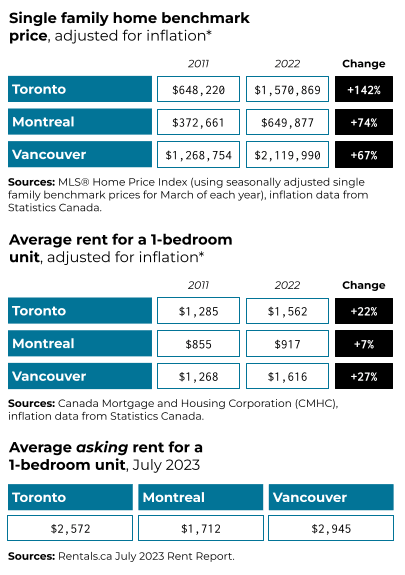
With these challenges in mind, we conducted an online, nationally representative survey of 1,000 Canadians in March 2023 to understand how Canadians feel about housing affordability and which policies they think are most effective at addressing it.
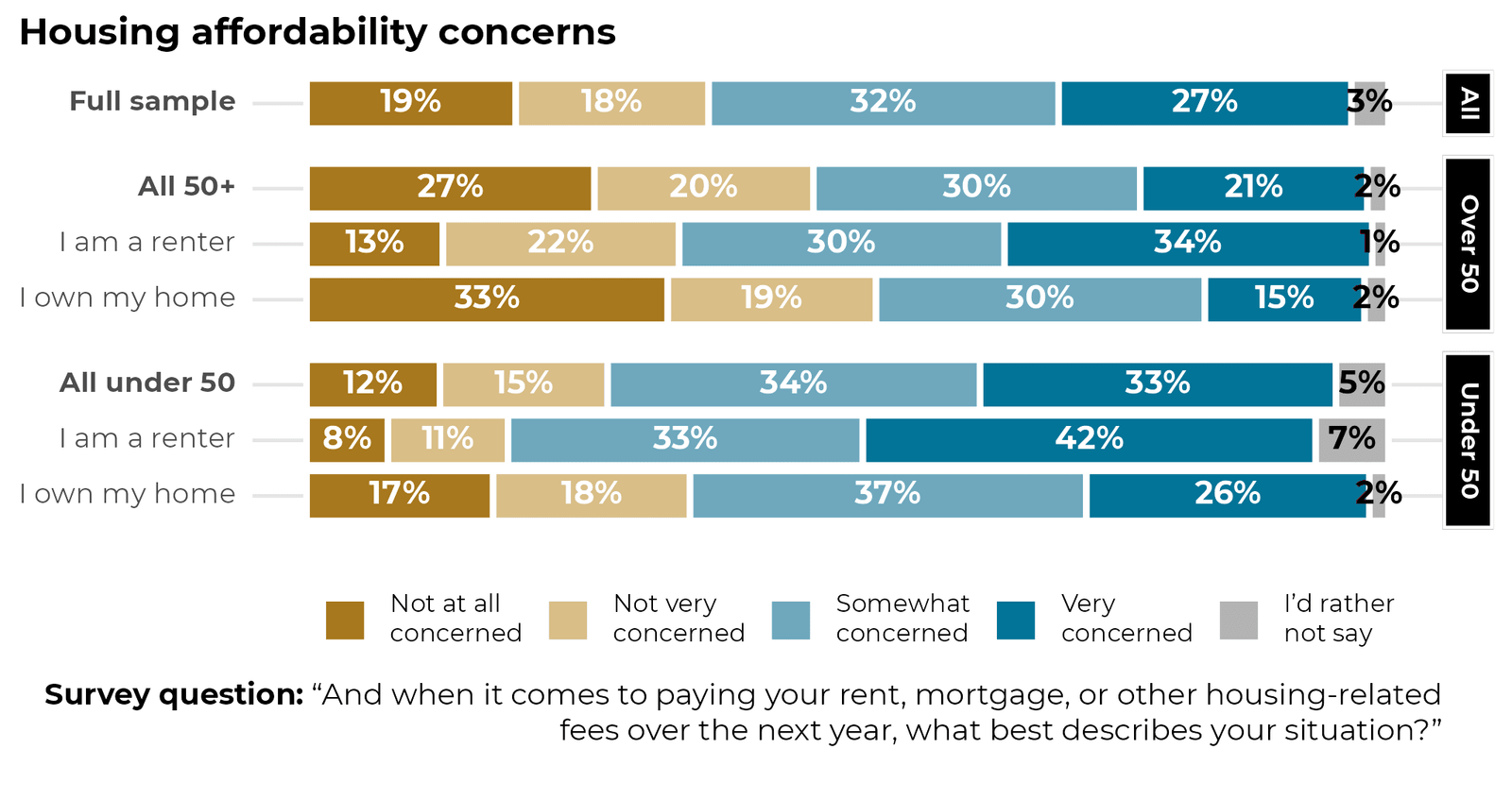
Most Canadians are at least somewhat concerned about meeting their housing costs, especially younger renters When we asked Canadians about their housing costs, 59% said they were somewhat or very concerned about meeting their housing-related costs over the next year. This concern is strongly tied to both age and tenure (whether one’s home is owned or rented). For instance, older (50+) homeowners, who are far more likely to have paid off their mortgages, were significantly less concerned (45%) than average, while younger (under 50) homeowners were somewhat more concerned (63%). Among renters, older renters were somewhat more concerned than average (64%), while three-quarters of younger renters were concerned. Overall, these results suggest that while rising housing costs have put pressure on both renters and owners, concern is greatest among younger renters.
Given these concerns, policies that meaningfully address housing affordability have become increasingly important. However, not everyone agrees on which policies are most effective. These views are shaped by one’s perceptions of the underlying causes, one’s position in the housing market, and, inevitably, one’s broader political beliefs. Our goal here is not to judge which policies are best, but to understand which policies are most acceptable to Canadians, and to whom.
Few Canadians are opposed to allowing more density in areas zoned for single-family homes

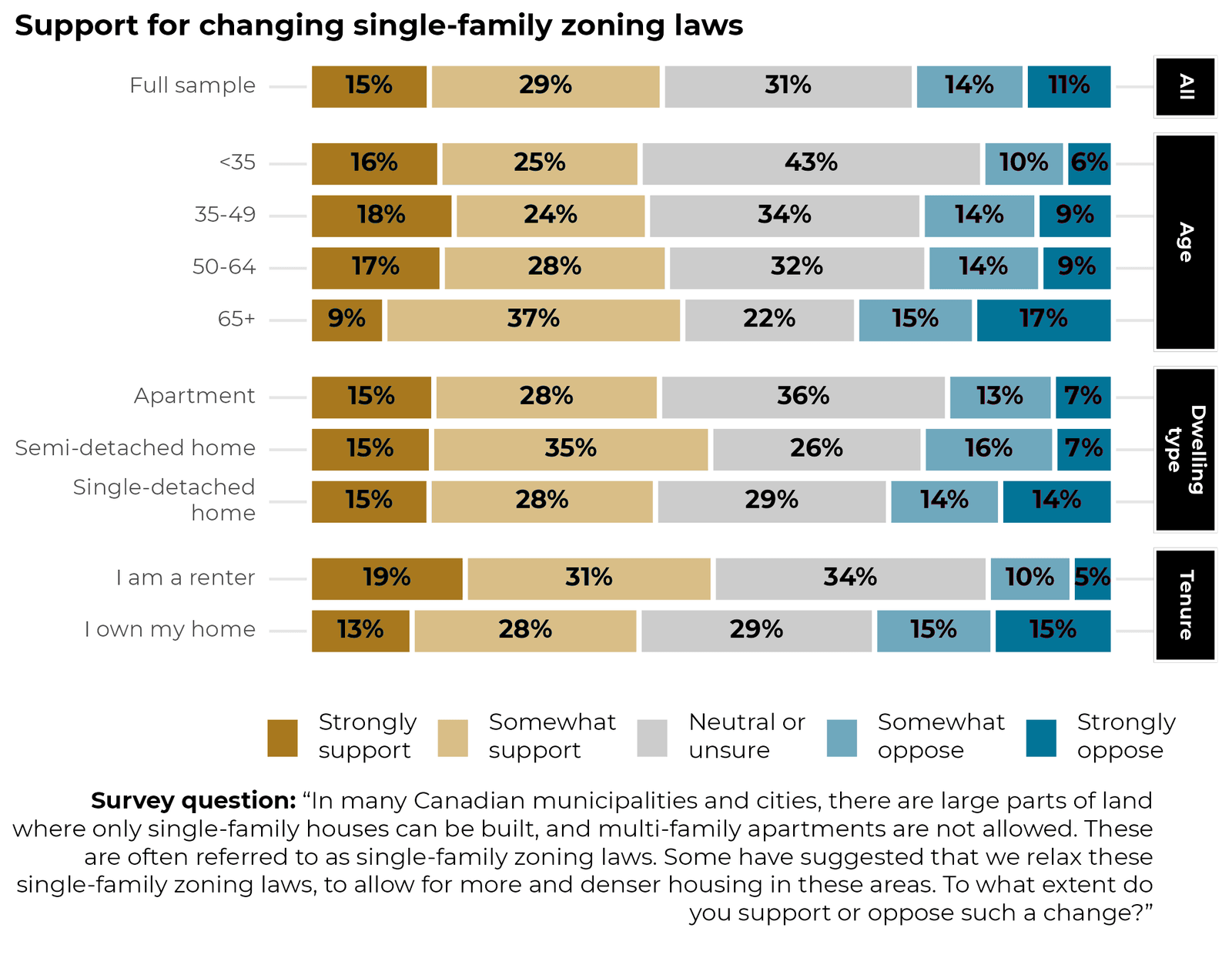
One policy that comes up often in debates over housing affordability is single-family zoning. Typically, these rules limit what can be built on a plot of land to single-family homes, excluding other types of housing like duplexes, townhouses, and apartments. To many, this type of zoning preserves qualities people value in their homes and neighbourhoods, including character, quality of life, yards and garden space, and privacy. However, opponents argue that single-family zoning drives up housing costs by limiting housing supply, particularly in areas with high demand. Some also point to issues such as suburban sprawl, car dependency, segregation, and negative environmental effects. Considering that single-family homes make up over half of all dwellings in Canada, we asked Canadians whether they support changes to single-family zoning laws that would allow for more density. Most people have probably not given much thought to residential land use regulation, and a significant share of respondents (31%) are neutral or unsure about whether zoning laws should change (especially younger respondents and renters).
However, the largest group of respondents (44%) would support relaxing single-family zoning laws to allow for more density, while only 25% oppose such a change. Interestingly, those who live in single-detached homes were as likely to support changing zoning laws as apartment dwellers. At the same time, single-detached home dwellers were less likely to be neutral than apartment dwellers, which means they also opposed the change somewhat more often.
Though zoning is typically a municipal responsibility, provincial governments have become increasingly involved. At the time of writing, the City of Victoria had passed its Missing Middle Housing Initiative, which replaces single-family zoning and allows multiple units on single lots, and the Province of British Columbia was planning its own legislation to allow 3 to 4 units on traditional single-family lots. When we asked Canadians who should have the most authority over single-family zoning, the largest share of respondents (37%) said municipal governments, while 23% said these decisions should rest with residents of the neighbourhoods where the rules would change. Though relatively few said higher levels of government should have this authority, younger respondents (under 35) were more likely to say the federal (21%) or provincial (23%) government should be in charge.
Banning foreign real estate investment is seen as an effective policy, banning short-term rentals less so Changing single-family zoning to allow for more density is one of many policies aimed, directly or indirectly, at housing affordability. There is no single policy that can solve the problem, and not everyone agrees on which policies are most effective. For this reason, we asked respondents to choose from a randomized, repeated list of housing policies, some already in effect to some extent and others only proposed, which they think are most and least effective at addressing housing affordability.¹ Our results suggest that some policies are seen as more effective than others. Overall, respondents saw banning foreign investors who do not live in Canada from buying homes as the most effective policy. This policy came into effect on January 1, 2023. Respondents were around 7% more likely to select it over the other 8 policies. However, some experts question whether foreign investment is a major driver of rising home prices; in Ontario, for instance, only 3.4% of residential properties have non-resident owners. The second most popular policy was rent (or vacancy) control: tying rent to the housing unit rather than the tenant, so that landlords cannot raise the rent when a tenant leaves. This policy, not in place in most Canadian provinces and territories with some exceptions, is widely debated. Though forms of vacancy control vary, supporters generally argue that it helps renters by discouraging evictions and large rent increases between tenants, while critics argue that it makes it harder for landlords to cover rising costs and may hurt renters in the long run by discouraging the construction of new rental housing. A less contested policy, allowing more secondary suites in homes, came third. Several policies fell in the middle, including waiving some taxes and fees for developers who build affordable homes, providing interest-free loans to renters at risk of eviction, charging no capital gains tax on the sale of one’s primary residence, and discouraging home flipping.
Charging an annual tax of 5% of a home’s value to owners who leave their secondary homes empty, a policy in place in Vancouver, was seen as somewhat less effective.
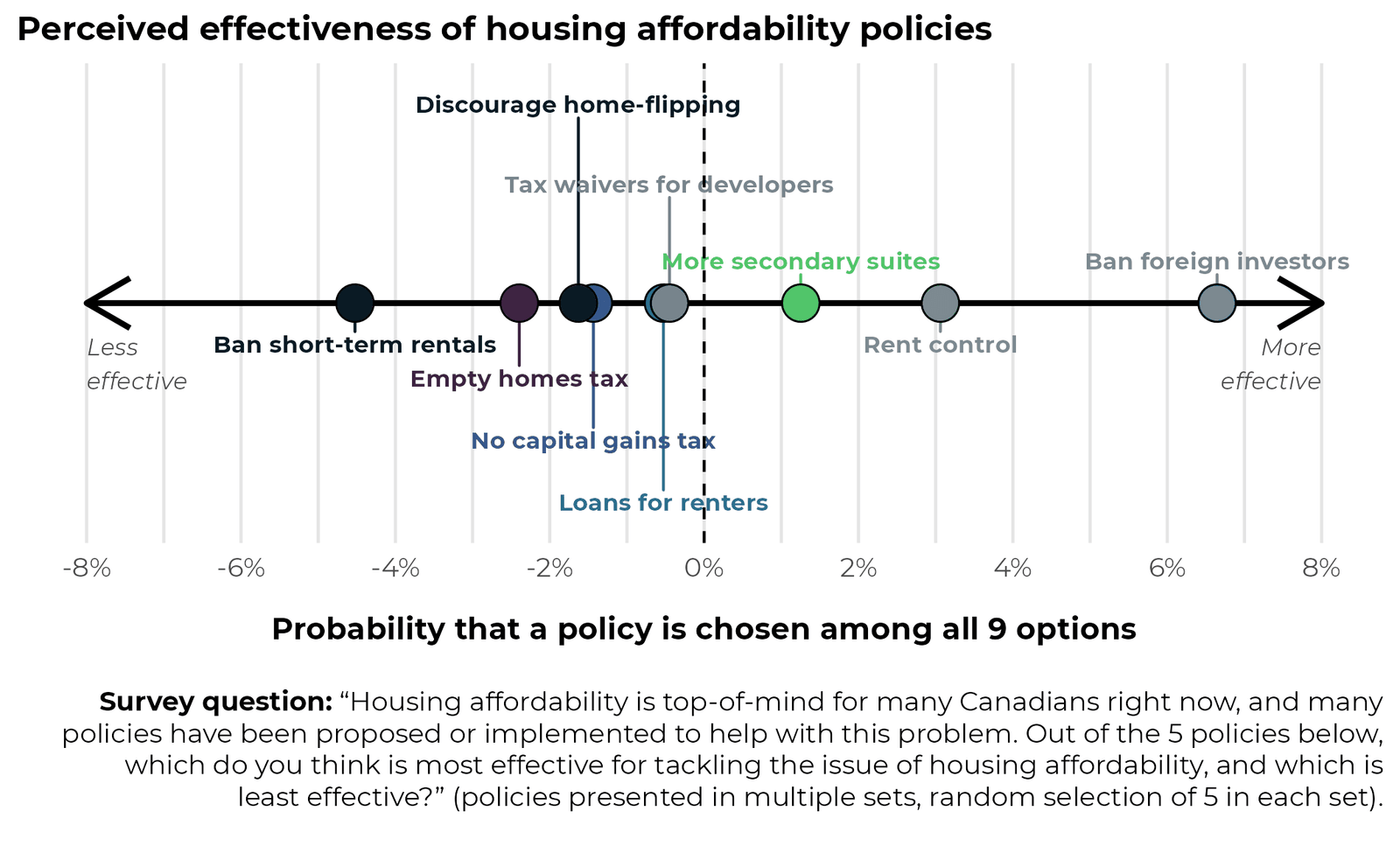
Notably, Quebecers were more likely to see banning short-term rentals as an effective policy. Shortly after our survey, a fatal fire in an Old Montréal building where several illegal short-term rentals were reportedly operating led to increased scrutiny of short-term rentals. Because we surveyed respondents before the fire, Quebecers, especially Montrealers, may have since become even more supportive of restrictions on short-term rentals. ¹ This survey method is often called Maximum Difference Scaling (“MaxDiff”) or Best-Worst Scaling. We computed the probability that respondents would choose one policy over another using a random parameter logit model (Hierarchical Bayes).
There is no single solution, but understanding public sentiment can help guide policy To some extent, our survey confirmed what is already widely known: many Canadians are concerned about meeting their housing costs. What is less clear is which policies Canadians see as most effective for improving affordability. Overall, we find little opposition to allowing more density in areas traditionally zoned for single-family homes, which, if enacted, may help increase housing supply. Banning foreign real estate investment was seen as one of the most effective policies, while banning short-term rentals was seen as less effective. Ultimately, housing policy spans municipal, provincial, and federal jurisdictions and will require coordination across all three. Understanding which policies are most acceptable to Canadians, along with research into best practices from other jurisdictions, can inform policymakers as they develop solutions.
Method
Data Sciences conducted an online, nationally representative survey of Canadians (N=1,000) in March 2023.
Originally published September 18, 2023. Findings reflect a survey conducted in March 2023; policy references are as of publication.