
Most Canadians feel safe where they live, but they’re split on whether it’s getting better or worse.
Understanding perceptions of public safety in Canada
This post shares findings from November 2022, part of Data Sciences' national public opinion research program. At the time of our survey, public safety had drawn considerable attention from policymakers and the public. In Vancouver, a series of unprovoked assaults became one of the top municipal issues in 2022, while debates over gun control continued at the federal level. With this in mind, we wanted to understand how Canadians perceive issues like violent crime, random attacks, and vandalism in their communities, as well as why they think these issues arise and who they believe is responsible for addressing them. These perceptions can influence individual behaviour and institutional decision-making, and can shape trust in and satisfaction with government and law enforcement. A 2019 survey from Statistics Canada found that 78% of Canadians were satisfied with their personal safety from crime, and 74% said crime levels in their neighbourhood had remained the same over the previous five years. Much changed after 2019: the COVID-19 pandemic affected everyone, violent crimes drew media coverage, and overdose deaths rose in many Canadian cities. For this reason, we surveyed a representative sample of 1,000 Canadians in November 2022 to provide an up-to-date picture of perceptions of public safety across the country.
Perceptions of community safety vary significantly across Canadian regions
Generally speaking, most Canadians feel safe at home: 60% of respondents rated their communities as relatively safe when it comes to issues like violent crime, random attacks, and vandalism (a rating of 7 or above on a scale from 1, extremely unsafe, to 10, extremely safe). However, perceptions varied significantly by region.
In both BC and the Prairie provinces (Manitoba and Saskatchewan), respondents rated their communities as significantly less safe (6.1/10 on average) than the national average (6.6/10). On the other hand, respondents in Atlantic Canada (7.3), Quebec (7.2), and Alberta (6.9) felt significantly safer in their communities than other Canadians.
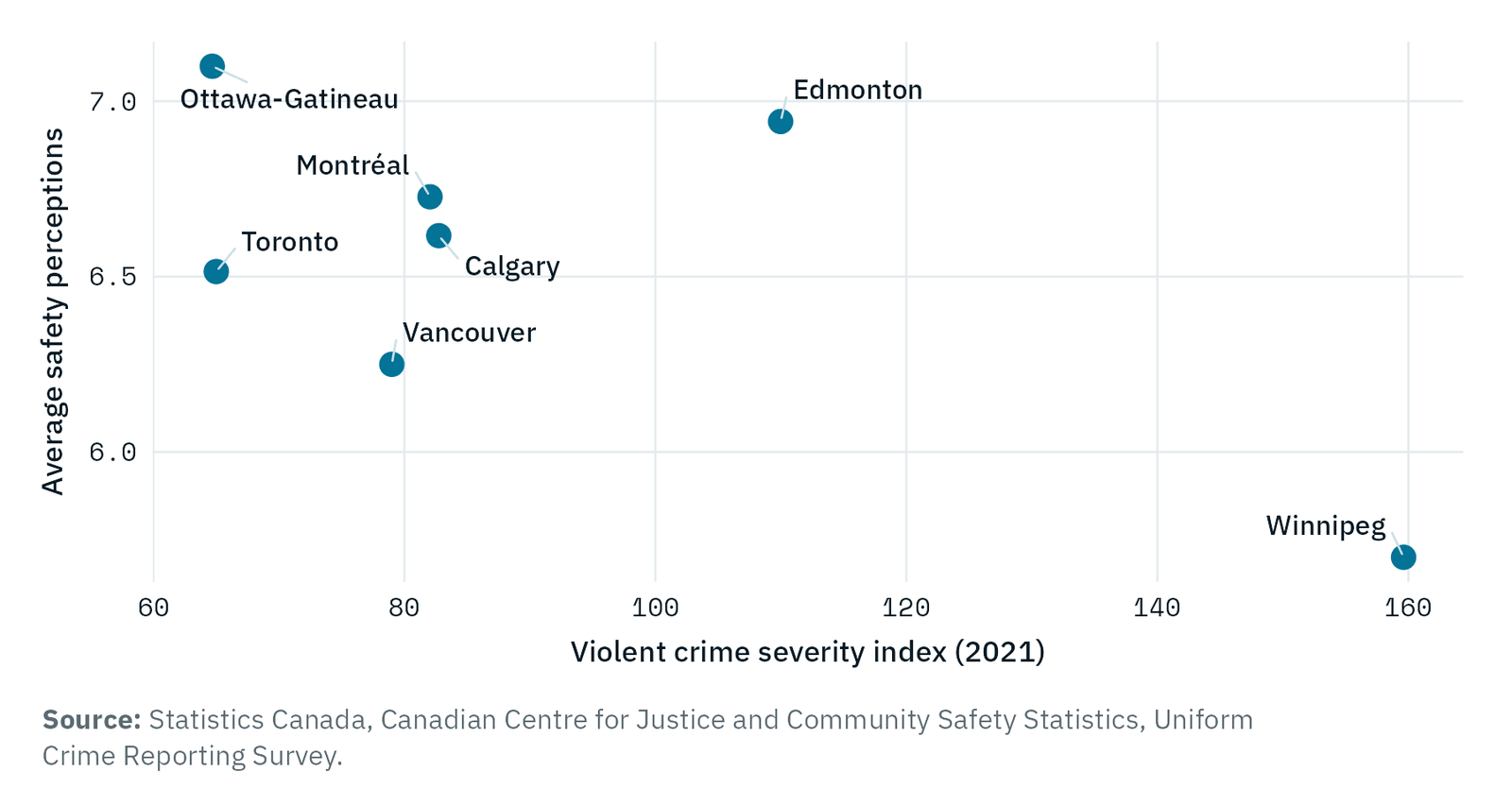
Looking more closely at Canada’s main metropolitan areas, publicly available crime data suggest that respondents tend to feel less safe in metropolitan areas with higher levels of violent crime. For instance, Winnipeg has the highest score among major Canadian metropolitan areas on Statistics Canada’s Violent Crime Severity Index.
Winnipeg is also where we see the lowest perceptions of community safety (5.7 out of 10). By contrast, the Ottawa–Gatineau area scores relatively low on the index, and respondents there see their communities as quite safe, with an average rating of 7.1. Edmonton is something of an outlier: perceptions of safety are relatively high (6.9 out of 10), yet its score on the index is higher than most other main metropolitan areas. One explanation may be how violent crime has changed over time. Edmonton’s Violent Crime Severity Index has been mostly flat in recent years, rising only 7 points since 2017. In Calgary, where safety perceptions are slightly lower (6.6 out of 10), the index rose 18 points over the same period, a more noticeable change for residents.
Age divides on feelings of safety
Research is mixed on how age affects personal feelings of safety.
In the Canadian context, we found a significant age divide: respondents older than 65 felt significantly safer (7.1) than younger respondents (6.5).
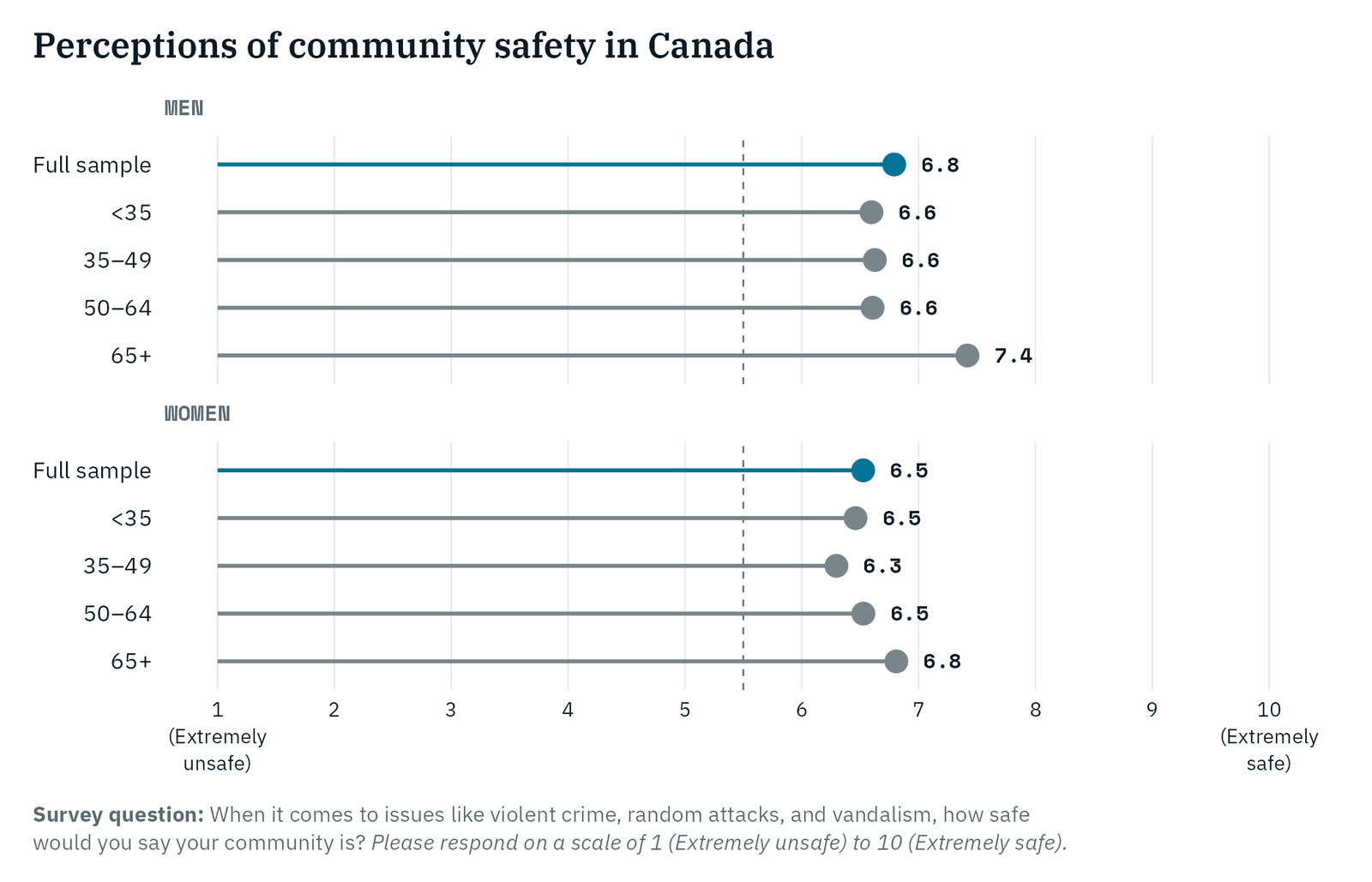
However, age and demographics may be only part of the picture. What may matter most is how a person’s socio-demographic profile interacts with the characteristics of the community they live in.
Community context matters
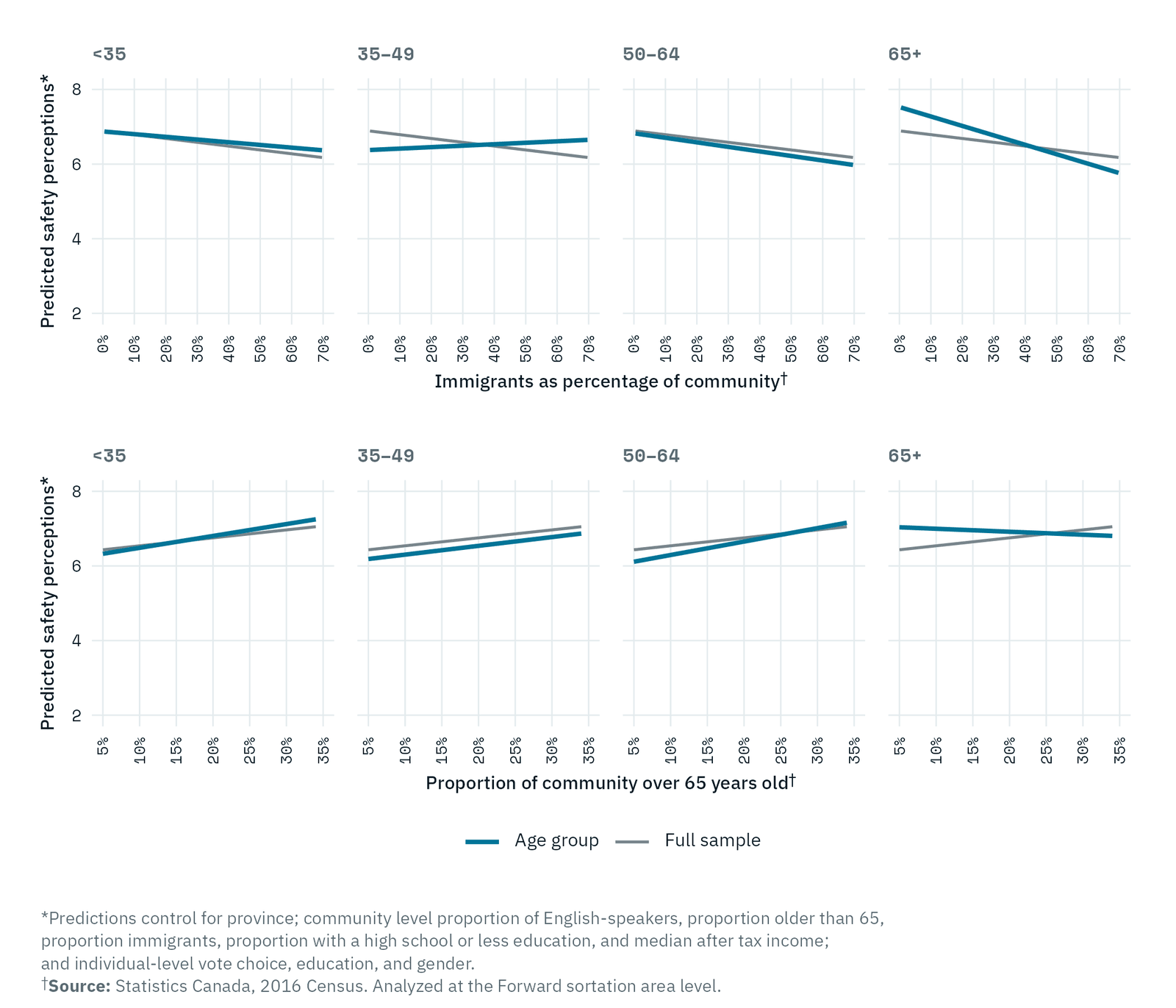
Community-level factors may affect perceptions of safety differently depending on one’s background.
After controlling for a range of individual and community-level factors, our models suggest that respondents under 65 feel safer in communities with older populations, whereas respondents 65+ report similar levels of safety regardless of their community’s age profile.
Canadians are split on whether their communities have become safer
Respondents are almost evenly divided on whether their communities have become more or less safe compared to five years ago: 29% feel their communities have become safer, 28% think they have become less safe, and 44% say safety levels have not really changed.
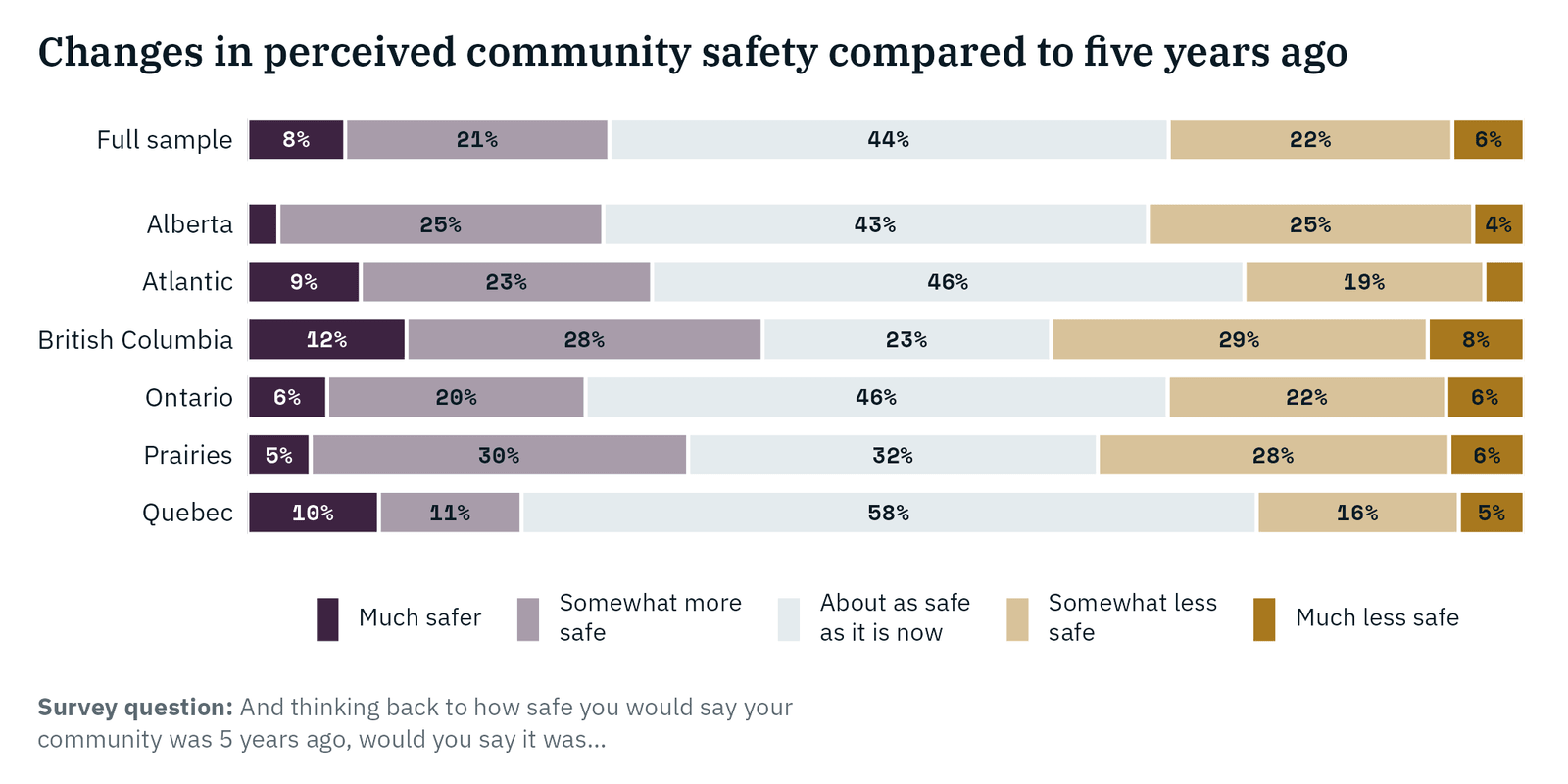
Respondents in British Columbia and the Prairie provinces (Manitoba and Saskatchewan) are more likely than those elsewhere to perceive a change in safety in their communities. But, as in Canada overall, opinions are split on whether safety has improved or worsened. According to Statistics Canada’s Violent Crime Severity Index, violent crime increased slightly in all provinces, with the largest increases in Saskatchewan and Manitoba, where levels were already well above the national average.
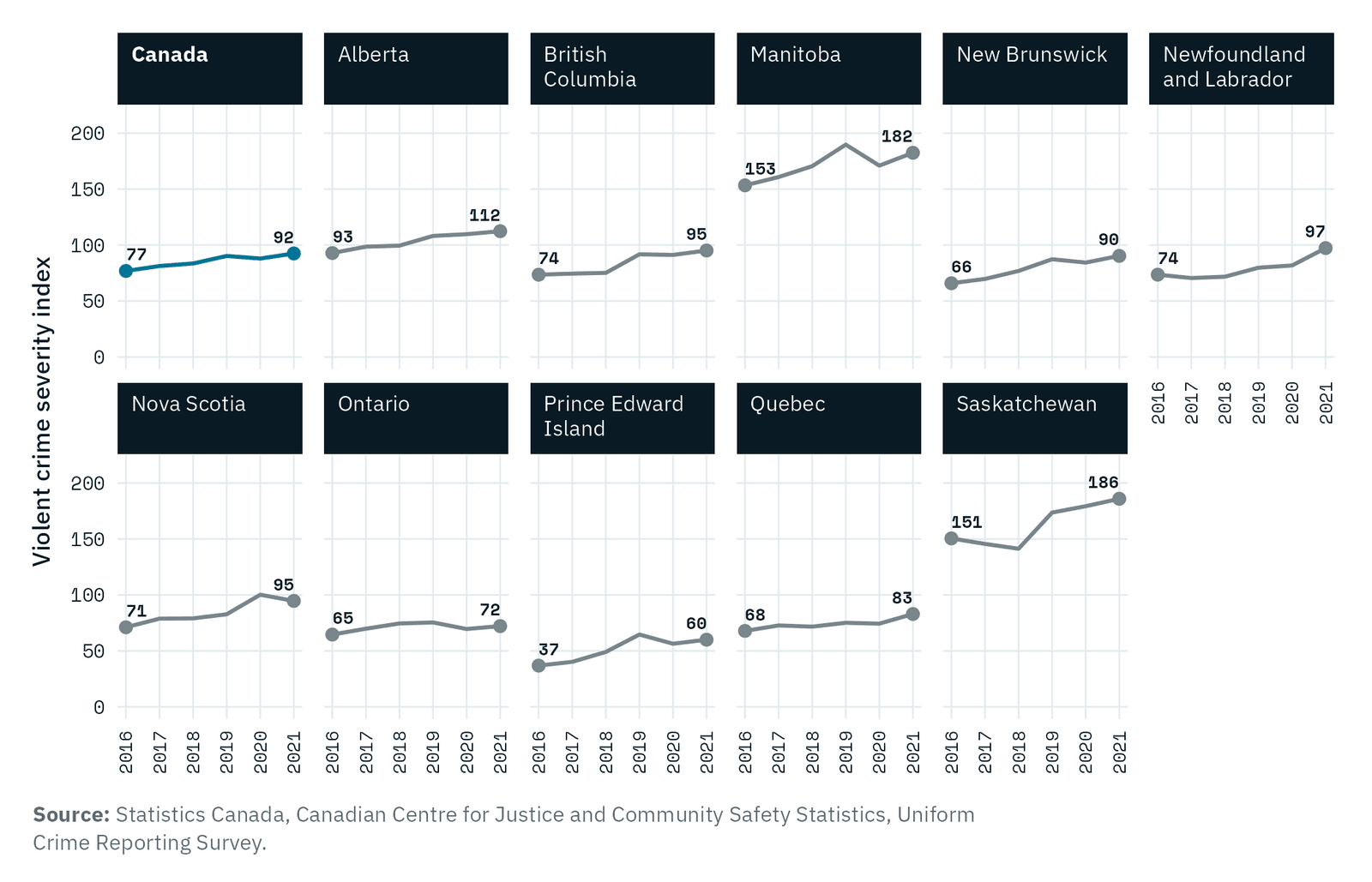
Comparing these statistics with our survey results suggests that perceptions of safety are highly contextual, likely shaped by lived experience, media coverage, and individual attitudes. Crime rates also vary considerably between communities within a province, so perceptions shaped by personal experience may not align with provincial-level trends.
Many Canadians, especially younger ones, see substance use and mental health as root causes When asked about the most important causes of public safety threats, 69% of respondents selected either drug addiction and overdoses or mental health issues. In cities like Vancouver, Toronto, and Calgary, local and provincial governments have proposed strategies both to improve treatment for people living with mental health and substance use challenges and to address related community safety concerns. Context matters here too: respondents in the cities and provinces with the highest rates of overdose deaths are significantly more likely to identify drug addiction and overdoses or mental health issues as the main causes of public safety issues.¹ There are also clear generational differences. For instance, 51% of respondents under 35 named mental health issues as one of the top two causes of public safety issues, compared with 33% of respondents over 65. Older respondents, meanwhile, are more likely than younger ones to attribute public safety issues to a lack of action from the courts and justice system.
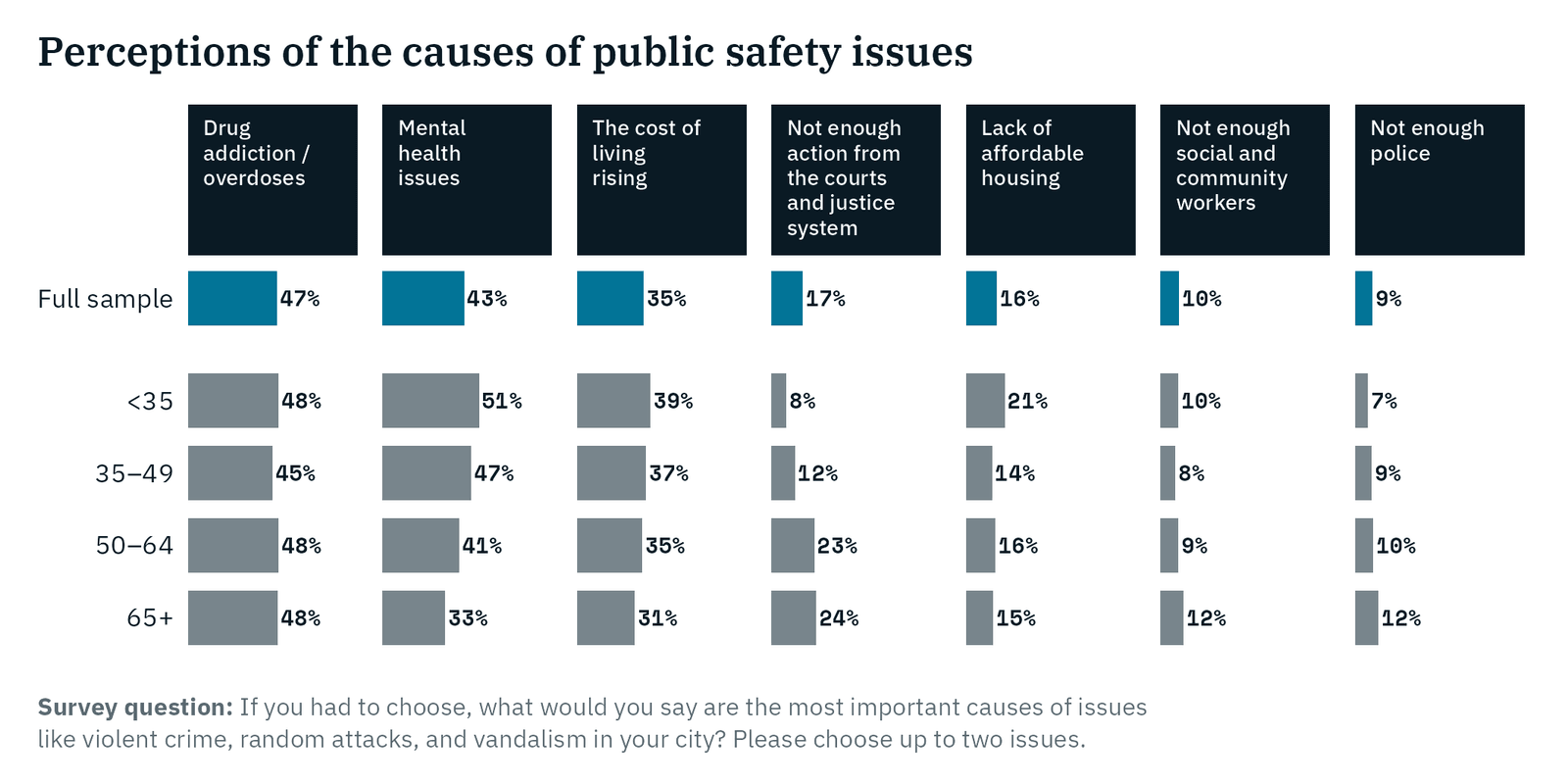
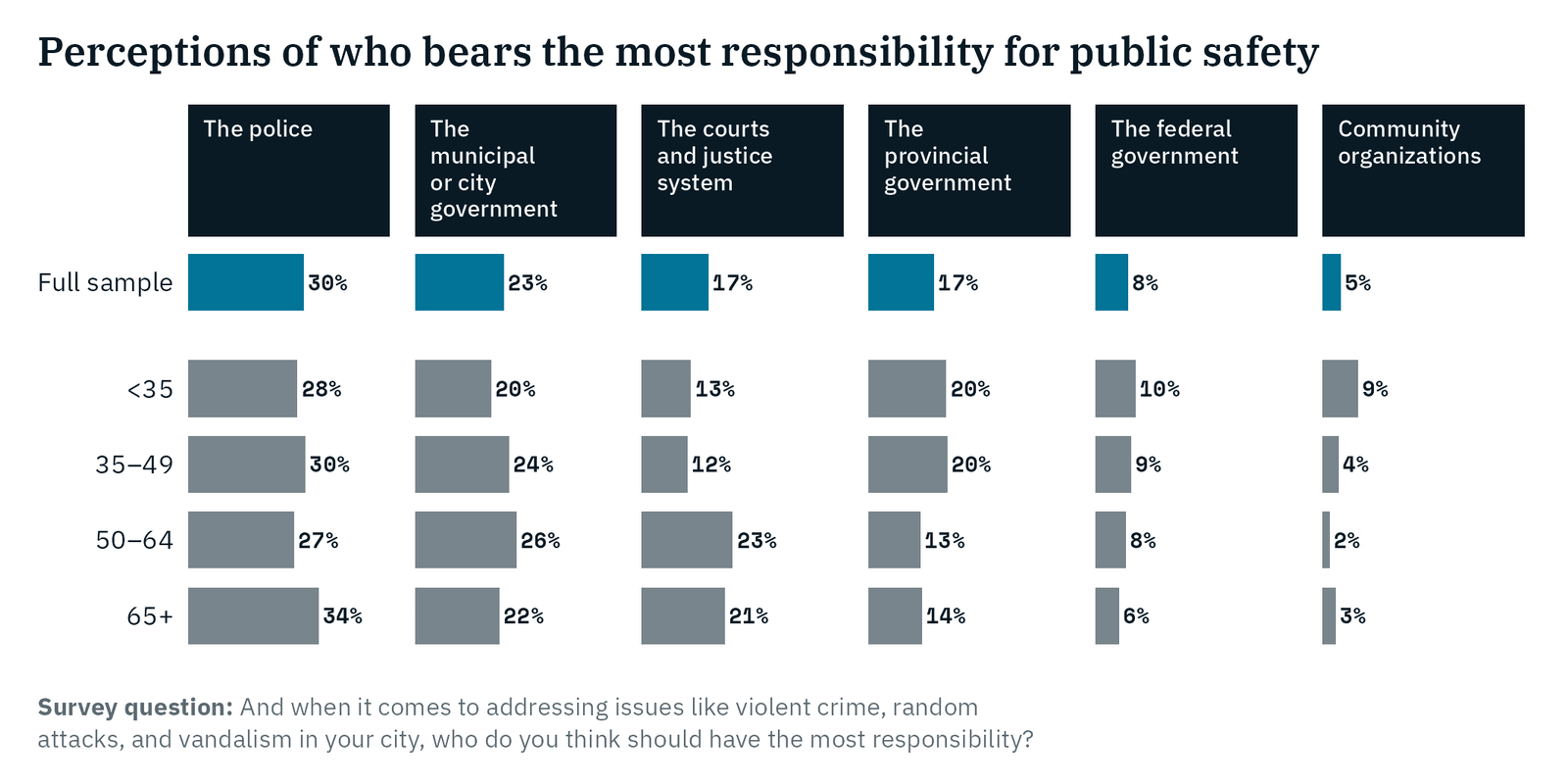
¹ For instance, 81% of respondents in BC selected drug addiction and overdoses or mental health issues as the main causes of public safety issues. BC accounted for 32% of all apparent opioid toxicity deaths in Canada between January and June 2022, despite representing 13% of the Canadian population. Source: Health Infobase Canada Canadians look to local institutions to address public safety Maintaining public safety involves cooperation among decision-makers and agencies at the federal, provincial, and municipal levels, and most Canadians are unlikely to have a detailed understanding of how these actors work together. So we asked: who is most responsible for public safety?
Nearly half of respondents pointed to local actors: the police (30%) or the municipal government (23%). This is perhaps unsurprising, since these institutions are generally seen as having the authority, resources, and expertise to address public safety. It is notable, though, that community organizations ranked last, given that some governments have emphasized the role of these groups in addressing issues many respondents identified as underlying causes, such as substance use, mental health, and homelessness. Again, we see a generational divide: respondents over 50 were around 10% more likely to say the courts and justice system should be responsible for public safety, while younger respondents were somewhat more likely to place responsibility on the provincial government.
Understanding public safety concerns is a step toward addressing them
Our results suggest that Canadians, on average, feel quite safe in their communities, but a significant share still have concerns, and many believe community safety has worsened. Responding to these concerns is complex. Many Canadians see mental health and substance use as root causes, and addressing them requires collaboration across government, law enforcement, health care professionals, and community organizations. Understanding how Canadians perceive public safety can help policymakers identify potential solutions and better respond to public concerns.
Method
Data Sciences conducted an online survey of a representative sample of Canadians (N=1,000) from November 17 to 23, 2022. We asked Canadians how safe they feel in their communities, how these feelings have changed over time, and which factors they think contribute most to public safety issues. Data were weighted by gender, age, and region to be representative of the Canadian population. The margin of error for a probabilistic sample of the same size is ±3%, and is larger for subgroups.
Originally published March 15, 2023. Findings reflect a survey conducted in November 2022.